 University of North Texas

AIM Flex Plan
What is Flex Plan?
Flex Plan is a new dashboard found in the AIM Instructor Portal which provides tools to support instructors in identifying what level of flexibility may be possible with their course through a short questionnaire. Once submitted, ODA staff and the student with accommodations have guidance on what may or may not fit the expectations, objectives and activities of the course.
Flex Plan is intended to improve communication, clarity and collaboration for an accommodation that often works differently from course to course. Having this information maintained in AIM allows instructor, student and ODA staff to work with the same information throughout the semester.
Background Information
Piloted in Summer 2025 and Fall 2025 semesters, we're excited to roll out the Flex Plan module within AIM, ODA's accommodation management system. This module will support faculty in many ways with managing Modification of Course Attendance Policy and Occasional Extension of Due Dates (up to 48 hours) accommodations. It will initially take a few extra minutes for faculty to complete, but it will save faculty much time in the end because it will align the student, faculty member, and ODA on how these accommodations will be implemented in their class for students with these approved accommodations. This form will also allow the University to stay in compliance with accommodation provision and therefore is required for faculty to complete.
The intent and expectations of the two flexibility accommodations (Modification of Course Attendance Policy and Occasional Extension of Due Dates) are unchanged. Flex Plan simply supports the process of identifying, communicating and managing how the accommodation is used throughout the semester, allowing greater support for instructors and students when disability-related absences are more frequent than anticipated or when flexible parameters are exceeded. Because flexibility is most often tied to the specifics of the course and not necessarily the student’s disability, instructors only fill out one plan per course (which can be copied between sections and even from up to the 10 most recent semesters).
Flex Plan is intended to streamline the availability of information about the level of flexibility determined by an instructor for their course and the opportunity for ODA staff to advise about options if issues arise throughout the semester.
How It Works
When a faculty member receives a letter of accommodation with either a Modification of Course Attendance Policy accommodation or Occasional Extension of Due Dates (up to 48 hours) listed, the accommodation description lists the student's responsibility of following up with their instructor on how this will be implemented and the faculty responsibility of completing the Flex Plan in AIM. It is important to note that the Flex Plan form in AIM is course-specific, NOT student-specific. Therefore, please do not put any student names in the Flex Plan.
The goal of this is to ensure clear communication about how this accommodation will be provided. Faculty will receive 3-4 automatic reminders to complete the Flex Plan in AIM. If it is not completed, it leaves more room for concern with provision and compliance risk.
Faculty should complete the entire form, even if they do not have a student in their class with a certain accommodation. (For example, Faculty should complete both the section on Occasional Extension of Due Dates and Modification of Course Attendance Policy, even if they do not have a student in their course with one of them at this moment in time.) By completing the form in its entirety, it ensures any other students who request accommodations later in the semester, related to flexibility, have the information needed for this accommodation to be implemented. After faculty have completed the form, it will be sent to ODA for review. Upon ODA's approval, it will be sent to the student. If the ODA has any questions or concerns, they will reach out to the faculty member.
This is an exciting new tool that will truly support all parties in ensuring students have the accommodations they need and save time and energy on figuring out the specifics.
AIM Step-by-Step Instructions
Initiating a Flex Plan
- Login to your AIM Instructor Portal
- Click "CONTINUE TO VIEW STUDENT ACCOMMODATIONS"

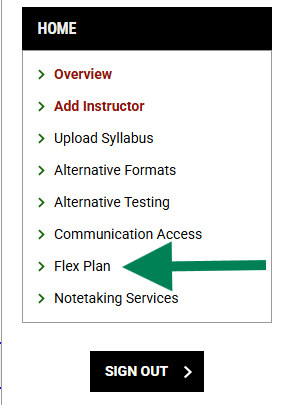
- On the left-hand side of the screen, click "Flex Plan"
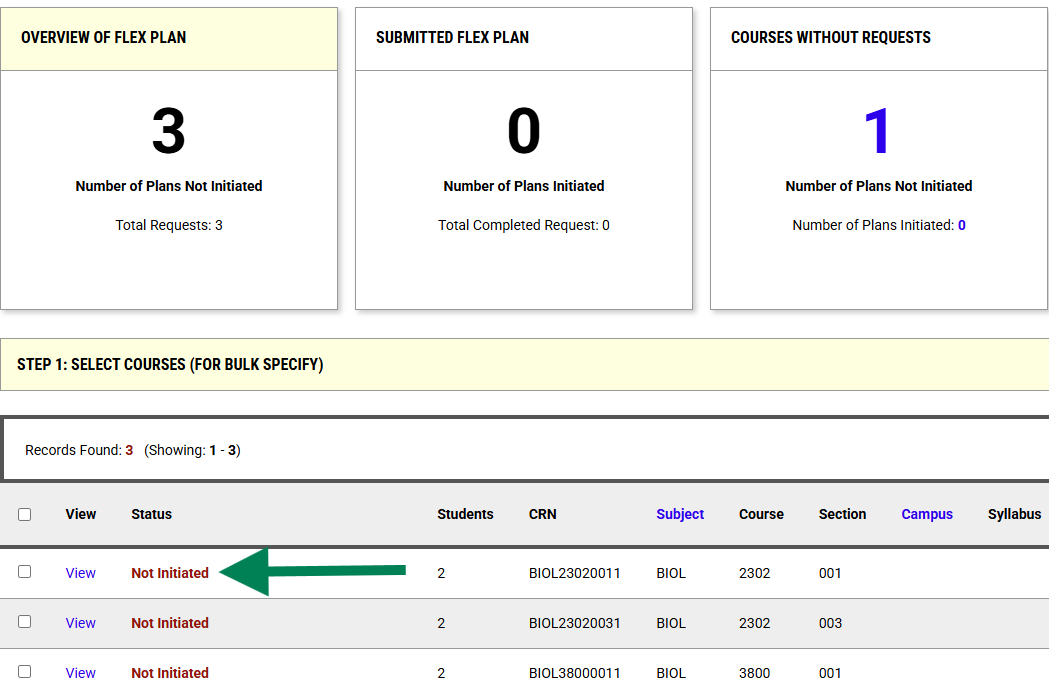
- Scroll down on the page and find the course that you want to complete a Flex Plan
for, press “View”. It will only show courses in which a student has either the Modification
of Course Attendance Policy or Occasional Extension of Due Dates (up to 48 hours)
accommodation.
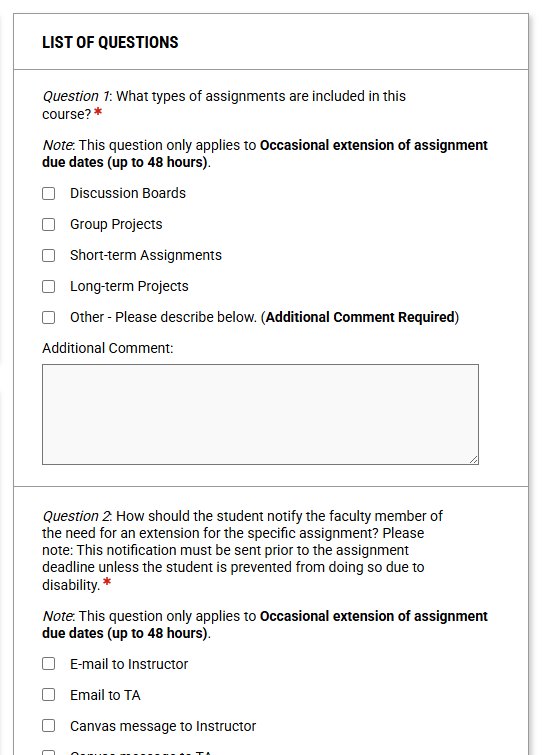
- Complete the Flex Plan form.
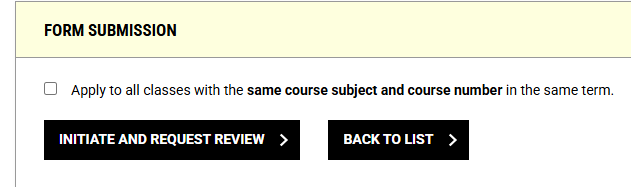
- At the bottom of the screen, you can select to apply these changes to all of your
sections with the same subject and course number, or not. To Once completed, click
“Initiate and Request Review’.
- Once submitted, ODA will review your submission to ensure parameters are clear and compliant and will then mark the Flex Plan as Completed. The student will receive an email with the details of your Flex Plan and can also view your responses in their AIM accommodations portal. You will also receive a copy.
Copying a Flex Plan to other Sections
To copy a Flex Plan across sections/courses/previous semesters, follow the steps for accessing Flex Plan in the Initiating a Flex Plan section above.
- Under Step 1, In the table of courses and flex plans, click the check box next to which course(s) you wish to transfer the content to.
- Under Step 2, click which course you would like to copy responses from.
- Click the black box titled "Specify Flex Plan for Multiple Courses."
- It will take you to a new page and you may make any edits you need.
- Click "Initiate Flex Plan for Review," at the bottom of the page.
Modifying the Flex Plan form
There is not currently an option for instructors to modify a Flex Plan. Please contact
the student’s assigned Access Coordinator listed on their accommodations letter or
email disability@unt.edu if you need to make changes to the Flex Plan for your course.
Information to Consider
Before completing the Flex Plan, please read the individual sections below. Then, the Flex Plan questions will guide you through this assessment:
Review for first portion- Occasional Extensions of Due Dates (up to 48 hours)
Regardless of a disability, all students are responsible for fulfilling the essential requirements of courses/programs/degrees. However, some students have disabilities that can impact their ability to complete assignments by the due date, including, but not limited to, students whose conditions are (1) episodic in nature, or (2) change and may result in problematic symptoms. One such accommodation is extended deadlines for assignments, which requires communication between the student, the Office of Disability Access, and the faculty member. The following guidelines are provided to assist with that process.
The Office of Disability Access can provide verification that a student has a disability which may address the legitimacy of an extension request, however, the ultimate decision regarding the number of extensions is at the discretion of the instructor. This document is intended to support faculty, student, and ODA regarding the reasonableness of deadline extensions.
Extensions are not automatically granted for work that is due. It is the student’s responsibility to discuss extensions on assignments with the faculty member before the assignments are due unless the student is incapacitated or completely unable to do so due to disability. In these cases, the student should contact the Office of Disability Access as soon as they are medically able.
When the student notifies their instructor they need to use the accommodation, the student should adhere to the agreed-upon plan and complete the work within the 48 hours as specified by the accommodation. Students will receive a copy of the Flex Plan with this information.
If the faculty member says extensions of deadlines are not possible, the student should notify the Office of Disability Access immediately. The Office of Disability Access recognizes the power differential between a faculty member and student and does not want this to interfere with the implementation of an accommodation. However, sometimes extensions are not possible, and the Office of Disability Access Coordinator will assist the student in navigating these situations.
Determining if Deadline Extensions are Reasonable
In general, extensions on assignment due dates may be considered reasonable in an academic setting. However, an extension would not be a reasonable accommodation if it would result in a fundamental alteration to the course (defined as a change that is so significant that it alters the essential nature of the course).
There are some classes or instances in which assignment due dates cannot be adjusted for an individual student without resulting in a fundamental alteration to the course. Such classes might include, but not be limited to, the following:
- those that rely on project-based learning where sequential assignments strictly build upon the material learned from the previous week(s), or
- classes where students are expected to work as a group and failure to complete an assignment or project on time would compromise the educational experience of other students.
OCR Guidance
The Department of Education’s Office for Civil Rights has provided specific questions to assess the degree to which strict adherence to assignment due dates is an essential part of a class. Faculty members should never unilaterally deny a student’s eligible accommodation. Faculty members should be prepared to provide a rationale if they believe that extending assignment deadlines is not educationally feasible; that is, how it would result in changes to essential components of the course.
The following questions have been provided by the Office of Civil Rights for this discussion:
- What are the essential course requirements?
- Would an extension (or multiple extensions) fundamentally alter the course?
- Does the fundamental nature of the course rely upon timely completion of assignments as an essential method of learning?
- To what degree does a student's failure to submit timely completion of assignments constitute a significant loss of the educational experience for other students in the class?
The accommodation should be provided unless the accommodation threatens the integrity of the course as offered. It is important that the student and course instructor discuss this accommodation. The conversationregarding this accommodation should be held at the beginning of the semester or as soon as the student presents the accommodations letter to the instructor. A conversation regarding this accommodation and a mutual understanding of how this accommodation will be provided should be established before late assignments or projects have become an issue. Instructors are only required to provide approved disability-related accommodations after receiving a letter of accommodation.
This accommodation is not intended to cover the following:
- Unlimited acceptance of late work - Extensions should be specific to individual assignments.
- Retroactive requests - Providing an accommodation letter does not reverse any previously missed deadlines. Some students may register with the ODA later in the term or wait to request their letter accommodation for the course. Presenting an accommodation letter mid-semester would not reverse any previously missed deadlines.
- Failure to follow agreed-upon plans for communication and submission of work.
- Personal organization and time management difficulties - Students must factor in the reality of their own personal situation and use time effectively to complete assignments. Taking a heavy course load, having a job outside of school or other family commitments do not justify allowing an accommodation even if they have a diagnosed disability that may otherwise support this accommodation.
Review for the second portion - Modification of Course Attendance Policy
Federal law requires colleges and universities to consider reasonable modification of attendance policies if needed to accommodate a student’s disability that impacts attendance. The disabilities covered under this accommodation are typically chronic or episodic in nature and may impact class participation as well as the ability to complete assignments, exams and quizzes. A disability-related absence as defined by the Office of Disability Access (ODA) is when a student is absent due to the symptoms associated with the student’s documented disability. This accommodation does not apply to absences for other reasons. The student is not required to present the professor with medical documentation verifying his/her disability- related absence. Please communicate with ODA if there is a concern.
The ODA requires that students with a disability-related need for a modification in a course attendance policy meet with their instructors to discuss the extent to which a modification may be reasonable for a particular class. This Flex Plan assists faculty in this discussion and allows both the student and instructor to have a clear understanding of what accommodations can be made for disability-related absences.
ODA staff are available to consult with instructors and students on issues concerning disability and attendance.
This accommodation allows for a reasonable number of additional absences and the ability to make up missed assignments, exams and quizzes within a specified timeframe.
Limitations of this accommodation assert the following:
- Unlimited and excessive absences are unreasonable.
- Use of this accommodation is not permitted for seasonal illness and disabilities not documented by the ODA.
- This accommodation may not alter the essential component of the course. Therefore, this accommodation may not be permissible where class attendance or participation is considered to be an essential component of the course.
OCR Guidelines - Assessing Whether Class Attendance is Essential
Professors are encouraged to review these questions/guidelines provided by the Office of Civil Rights (OCR) to assess if attendance is an essential component of their course:
- Is there classroom interaction between the instructor and students and among students?
- Do student contributions in class constitute a significant component of the learning process?
- Does the fundamental nature of the course rely on student participation as an essential method for learning?
- To what degree does a student’s failure to attend constitute a significant loss to the educational experience of other students in the class?
- What do the course description and syllabus say?
- What method is used to calculate the final grade?
- What are the classroom practices and policies regarding attendance?
Evaluating the Role of Class Participation
Our focus in this accommodation is on the essential element of participation. With that in mind please review the following questions below, as ODA may need this information. These questions are designed to help identify the role in-class participation has toward students meeting course outcomes/objectives. If concerns come up, please contact ODA:
- What does the syllabus state regarding attendance, participation, and deadlines? Have exceptions been made in the past? What is the role of these policies as it relates to the course?
- What stated learning outcomes/objectives require participation?
- Is attendance factored in as part of the final course grade? If yes, how? What is the percentage of the grade? Is this a course, department, or college policy?
- Is there classroom interaction between the instructor and students, and/or among students?
- Is the format of instruction primarily lecture or interactive? Does instruction and learning rely on specific elements from the previous session or assignment?
- Does the course rely on student participation as a method for learning?
- What is the impact on the educational experience of other students in the class?
- Is there content only offered in class?
- Do student contributions constitute a significant component of the learning process? (e.g. discussion, presentations, role play)? What is the impact on the educational experience of other students in the class if a student is absent or misses a deadline? Are assignments used as class content when they are due? (e.g. problem sets reviewed as the first lecture on that content)
If attendance can be justified as an integral part of how the course is taught and/or how learning is to be demonstrated and measured, there can be a point at which disability-related absences cannot be reasonably accommodated. If at any point, the instructor and/or the student have any questions or concerns about this process, this Flex Plan, and/or the provision of this accommodation, the Office of Disability Access should be notified as soon as possible so they can address the concerns and work to resolve them.
If the maximum number of allowed absences is exceeded during the semester, the student and instructor must meet to discuss an appropriate course of action (such as: student will be granted an incomplete; student may need to consider to withdraw from the course; the number of absences allowed will be reviewed; penalties outlined in syllabus will apply). The ODA should be informed as soon as possible so they can work with the instructor and student to come to a reasonable solution.
A disability related absence can impact the student’s ability to turn in homework, assignments, or projects due the day of a disability related absence. The disability may also impact the student’s ability to complete exams or quizzes at the designated time. A section on the Flex Plan will help detail a reasonable plan of action to submit make-up missed assignments or exams within a specified timeframe.
FAQs
Question: Did you change the mechanics of how either the Modification of Course Attendance Policy or Occasional Extension of Due Dates (up to 48 hours) accommodations work?
Answer: No. These accommodations are unchanged. The only aspects of the accommodations language that have been modified relate to the guidance for instructors to complete a Flex Plan in their AIM Instructor Portal.
Question: Does a Flex Plan need to be submitted for every student with either the Modification of Course Attendance Policy or Occasional Extension of Due Dates accommodation in my courses?
Answer: No. Because flexibility would be determined based on the expectations, objectives and outcomes of a course, a Flex Plan would typically apply to all students in the course. Once you complete a Flex Plan for your course, it is automatically applied to each student with the accommodation who has already requested accommodations and for any additional students who request their accommodations afterward. Additionally, you can copy a Flex Plan submitted for one section to any other courses or sections being taught during the current semester. If you submitted a Flex Plan in one of the past 10 semesters, you can also apply this previously-submitted plan to any current plans that have not yet been initiated.
Feedback Requested
We welcome your feedback. Please contact us at disability@unt.edu with any questions or concerns.